Before You Can Do Better, You Have to Feel Better
And reading this is already a start.
You know the feeling.
You wake up and something is already heavy.
Not a specific problem. Not a crisis. Just a low hum of not-quite-right sitting in your chest before you've even reached for your phone.
And your first instinct — because you are a high-achiever and this is what you do — is to think your way out of it.
Make a list. Set a goal. Push through.
But here's the distinction nobody talks about:
Rumination keeps you stuck.
Intentional thought sets you free.
The difference between the two?
One spirals inward looking for answers. The other deliberately redirects your brain toward what is already true, already good, already present.
And the most powerful intentional thought available to you right now?
Gratitude.
Your Brain Cannot Hold Fear and Gratitude Simultaneously
This isn't positive thinking.
This is neuroscience.
Fear and gratitude cannot coexist in the same neurological moment. When you deliberately activate gratitude — real, felt, specific gratitude — your brain shifts out of threat response and into an entirely different operating state.
Not because you've suppressed the problem.
Because you've changed the channel.
Try it right now.
Think of one specific thing — not general, specific — that you are genuinely grateful for in this moment.
Not "my health." But "the way the light looked this morning." Not "my success." But "that one person who believed in me before I believed in myself."
Feel the difference?
That subtle shift in your chest?
That's not sentimentality.
That's your nervous system changing state in real time.
Your Brain Is Not the Problem — Your State Is
When you're in a low state — contracted, heavy, flat — your brain isn't broken. It's doing exactly what it was designed to do. It's protecting you.
The nervous system reads "I feel low" the same way it reads "I am in danger." And a nervous system in protection mode does one thing above all else: It conserves.
It narrows your thinking. It dims your creativity. It mutes your intuition. It makes the future feel smaller than it actually is.
And here's what the productivity world won't tell you:
No strategy, schedule, or willpower can override a dysregulated nervous system.
Your output is a direct reflection of your internal state — not your effort.
When you are regulated — nervous system safe, body present, identity coherent — you have access to the fullest version of yourself. Ideas flow. Decisions land. Creativity ignites.
When you are dysregulated — running on stress, comparison, or depletion — you are operating on a fraction of who you actually are.
This is especially true for high-achievers experiencing Romantic Imposter Syndrome — where the same person who leads boardrooms collapses into self-doubt and unworthiness in intimate relationships.
When the nervous system is dysregulated, the Imposter runs the show. In your career. In your relationships. In the quiet moments when you wonder if you are truly enough.
You're not lacking discipline. You're lacking recalibration.
State change is not a luxury. It is the foundation of everything.
The Most Dangerous — and Most Powerful — Tool You Already Have
You are always imagining something.
The question is what.
Right now, without even realizing it, your imagination is painting a picture. Of how the conversation will go. Of what they think of you. Of whether you are enough. Of what the future holds.
And here's the part that changes everything:
Your nervous system cannot tell the difference between–
something vividly imagined and something actually happening.
Read that again.
When you spiral into worst-case thinking — rehearsing the rejection, the failure, the moment it all falls apart — your body is living that reality. Cortisol rising. Chest tightening. World narrowing.
You haven't experienced the thing yet.
But neurologically?
You already have.
And the opposite is equally true.
When you deliberately, specifically, sensually imagine the best possible version — the love that feels easy, the work that flows, the version of you who is fully expressed and deeply met — your nervous system starts operating as if it's already real.
This is not magical thinking.
This is the neuroscience of imagination.
This is why NeuroTrance works — because when we recalibrate the subconscious through guided trance states, we are not bypassing reality. We are rewiring your relationship to it.
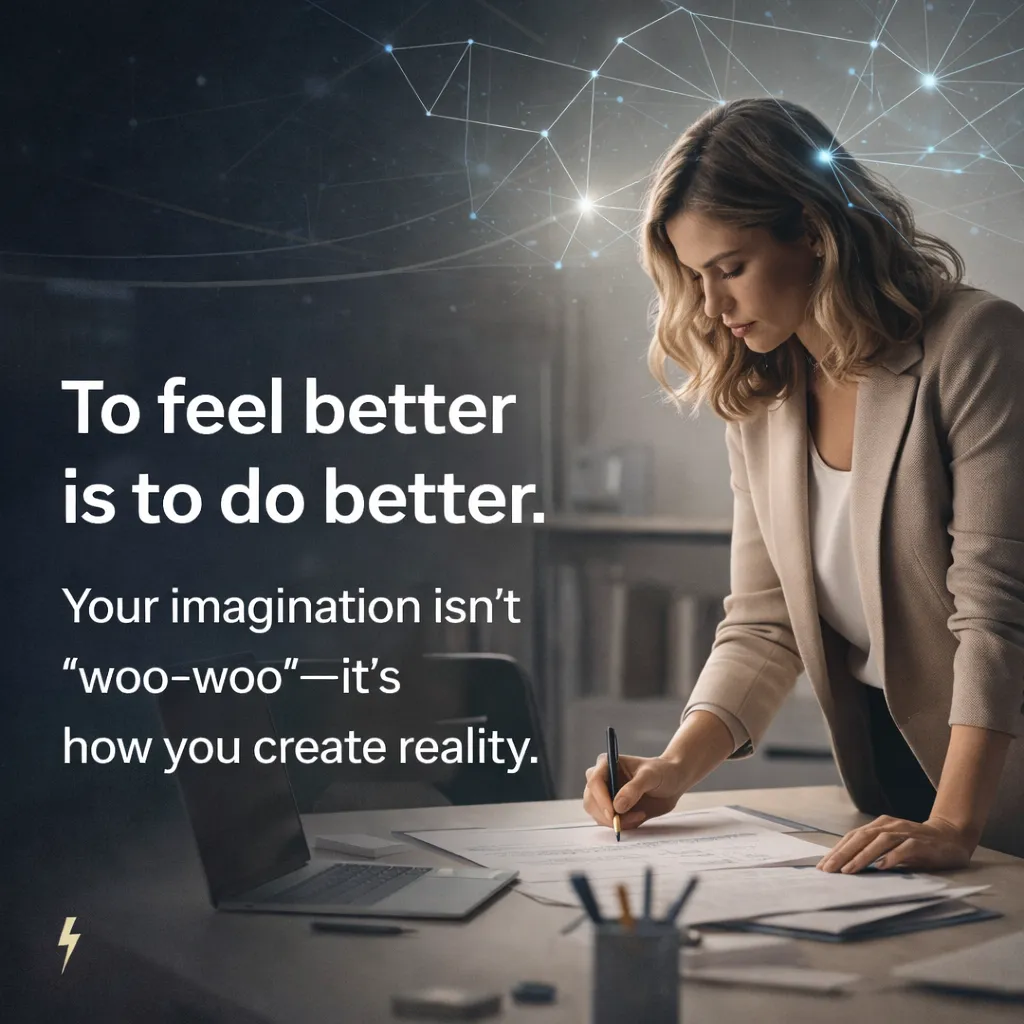
Your imagination is not an escape from reality.
It is the architect of it.
So the real question is never "what is happening to me?"
It is always: "what am I painting?"
What a State Shift Actually Feels Like
This is where it gets good.
Because a state shift doesn't require a retreat, an overhaul, or a perfect morning routine.
It requires one moment of genuine interruption.
Gratitude — specific, felt, real. Not a list. A moment of actual recognition that something good exists right now. Neuroscience confirms that gratitude activates the brain's reward circuitry, releasing dopamine and serotonin — the very chemicals that regulate mood, motivation, and connection.
One breath taken so slowly your body actually notices it. Slow exhales activate the parasympathetic nervous system — your body's built-in state reset.
One question — not "why do I feel this way" — but: "What would feel like expansion right now?"
One song that moves something in you before you've consciously decided to let it.
One step outside where the air hits your skin and reminds you that you are present, alive, and here.
Maybe it's movement. Maybe it's music. Maybe it's five minutes of silence where you stop performing — even for yourself.
(Notice — are you breathing differently than when you started reading this?)
That's a state shift.
Small. Real. Neurological.
Romantic Imposter Syndrome and the State You Bring to Love
Here's what most people don't realize about Romantic Imposter Syndrome:
The state you arrive in determines the love you receive.
When high-achievers enter relationships from a dysregulated, Imposter state — scanning for threat, measuring their worth against others, waiting to be chosen — they attract and create dynamics that mirror that internal fragmentation.
But when they arrive as the Icon — regulated, coherent, internally referenced — everything shifts.
The conversations change. The choices change. The connections change.
You cannot love freely from a contracted state.
You cannot receive fully from a place of scarcity.
State change is not just personal development.
For high-achievers navigating imposter syndrome in relationships, it is the most direct path to the love they actually deserve.
You Are Not Behind
One more thing before you go back to your day.
That heaviness you woke up with?
It is not evidence that something is wrong with you.
It is not proof that you are failing.
It is not a sign that you need to try harder.
It is simply a signal that your system needs recalibration.
Not punishment.
Recalibration.
The high-achiever's instinct is to push harder when they feel behind.
The Icon's instinct is to come back to themselves first — because they know that everything flows better from there.
You are not behind.
You are one state shift away from the version of you that knows exactly what to do next.
The NeuroTrance Question
What are you genuinely, specifically grateful for right now?
Let that land in your body — not just your mind.
Now close your eyes for just 30 seconds.
See the best possible version of your day unfolding. Not perfect — alive. Feel what it feels like in your body when things flow. When you are fully yourself. When you are met exactly where you are.
Inhabit that for 30 seconds.
That is not fantasy.
That is your nervous system receiving its next instruction.
Now ask: what would feel like expansion from here?
Start there.
Everything else follows.